
Ferrari 288 GTO
Ferrari’s first true modern supercar didn’t arrive quietly—it rewrote the rules.
The 288 GTO wasn’t just built to meet racing requirements. It became a turning point.
For the first time, Ferrari paired a V8 with twin turbos—unlocking a new level of performance. What started with the 308 evolved into something far more serious: wider, lighter, sharper. Kevlar and fiberglass replaced tradition.
The engine moved from transverse to longitudinal. Everything had a purpose.
This wasn’t just a car—it was a testbed for the future of Ferrari.
And it showed exactly where they were headed.
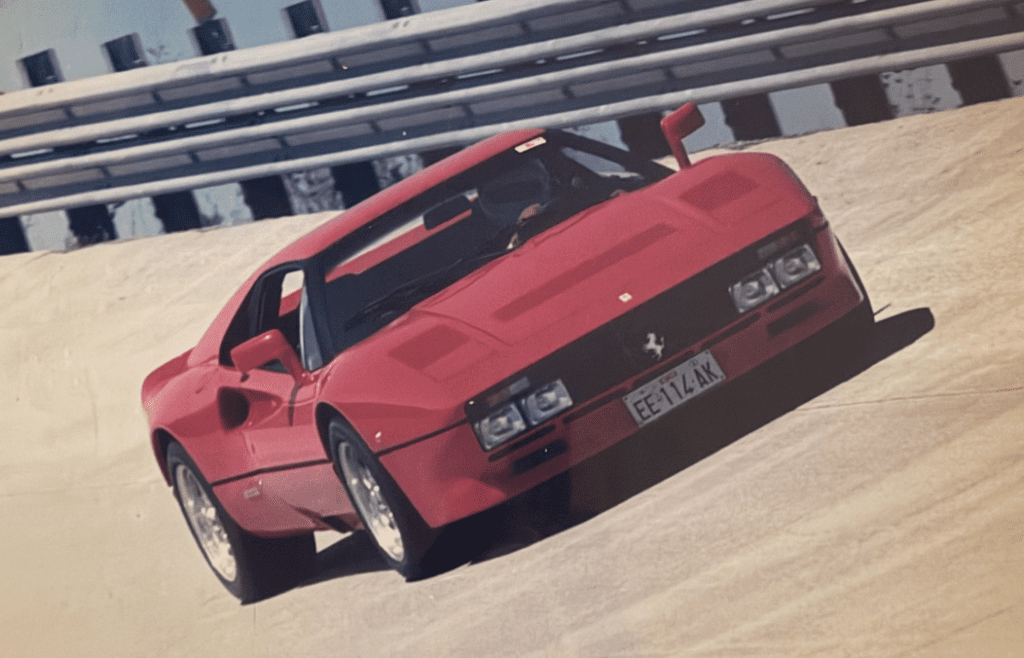
In 1986, Rogér Andrey—working in conjunction with Ferrari North America—was entrusted with something special: putting his family’s Ferrari 288 GTO to the test.
At the Transportation Research Center in Ohio, Road & Track conducted one of the most talked-about high-speed evaluations of the decade. The goal was simple—find the limits.
The result? The 288 GTO secured its place among the fastest road cars in the world.
At a time when performance boundaries were being pushed further than ever before, the GTO stood at the leading edge of Ferrari’s turbocharged evolution—proving that the future had already arrived.
Powered by a 2.8-liter twin-turbocharged V8, producing approximately 400 horsepower, the 288 GTO represented a dramatic shift from Ferrari’s traditional naturally aspirated engines. Its combination of lightweight construction, advanced materials, and forced induction delivered performance that was nothing short of extraordinary for the mid-1980s.
During testing, Road & Track recorded a top speed approaching 190 mph, placing the GTO firmly among the elite high-performance machines of its time. Equally impressive was its acceleration, with 0–60 mph achieved in under five seconds—figures that rivaled or surpassed many contemporary supercars.
What made the result even more significant was the context: the 288 GTO had been conceived as a homologation special for Group B racing, yet it proved just as formidable on the open road. The test underscored Ferrari’s ability to translate competition engineering into a road-going package, bridging the gap between race car and production supercar.
In retrospect, the Road & Track test not only validated the GTO’s capabilities but also signaled the arrival of a new generation of Ferrari performance—one that would soon culminate in the legendary F40.